QAT
Once there was an exhibition about Yemen in the Tropenmuseum. Both Daniel and I had been there independently. What we saw really appealed to Daniel and me. A country with a medieval character and which made an authentic impression. “We have to go there”, we sighed. And we kept repeating that over the years, every time we saw each other at family parties or when we just dropped by each other. Until one day we decided that it was enough and decided to go. Because we both had small children, it couldn’t be a long trip. Eight days and during that time we also wanted to spend 48 hours in Jordan to swim in the Dead Sea and to walk through the gorge to visit the hidden rock temples of Petra. When we arrived at Sana’a International Airport at midnight after the Jordanian adventure, a small Arab in an ugly light blue suit was waiting for us. It was Brahim, a friend of the only Yemeni I knew in the Netherlands. He would be our driver for the coming week. In Yemen, foreigners are not allowed to drive a car themselves, so Brahim took on that task with gusto. With great haste he brought us to a hotel in the capital, where we collapsed exhausted in a room with colored windows.
The next morning we were woken up by the singing of many men. When we pushed the curtains aside and looked outside through the colored windows, we saw a whole column of soldiers running through the streets at a walking pace, singing. That was how the Yemeni army trained. Curious about what it would be like on the streets, we put on our clothes and walked outside. The hotel was located on a somewhat larger street with many shops. Many of the businesses were still closed, but here and there the shopkeepers opened the large, light blue, iron doors and started rummaging through their goods. One small entrepreneur was baking fragrant filled pancakes on a large round plate. A little further down the large street we turned left. It was as if we had ended up in 1001 nights. We were standing in a small market full of activity. Small men in long white robes were walking back and forth busily. Over their robes they wore a jacket and around their waists a wide belt with a curved dagger in a green powdered case. Their heads were protected from the sun by a checked cloth, like the one we still remember from the Palestinian resistance fighter Yasser Arafat. The women, on the other hand, glided through the decor like black shadows. Everything about them was black, their long robes, the niqab; even their hands were covered with black gloves. Only their dark eyes peered through a narrow slit that had been left open in their clothing. On their heads they carried baskets with large, flat loaves of bread, intended for sale. The men at the market were not so much interested in the flat loaves of bread but more in the bundles of branches that were spread out on the ground. It looked like a privet hedge. For a few dozen rials they managed to get hold of a bundle and walked down the street with it under their arm. A strange spectacle: armed men in dresses with trimmed privet and black shadows under loaves of bread. It was as if we had been taken a few hundred years into the past in a time machine. Those bundles of branches were qat. We would soon find out what effect those bundles of qat had. Around noon the men became a bit agitated and looked for a place to chew the qat. The result is that the entire nation is disabled by the qat in the afternoon. The entire economic life comes to a standstill. If you want to buy something at 3 o’clock in the souk of Sana’a, you will only find disinterested businessmen who don’t care whether you buy anything from them. The soldiers at the roadblocks stare vaguely into your car and then let you drive on. After this first culture shock at the qat market, we hurried back to have breakfast before Brahim would come to pick us up. We would first travel east to see the faded glory of a caravan city buried under sand and to wander through the remains of the palace of the Queen of Sheba. All this happened under the supervision of an armed soldier, who took a seat in our car. Apparently the authorities were afraid of kidnappings. It happened regularly that Westerners were kidnapped by rebellious desert tribes. Weapons and jeeps were then demanded in exchange for their release. It is said that there was once a Western man who did not adhere to the protocol of the rebels. They expected the kidnapped person to behave properly in exchange for the hospitality that was offered to him. The Westerner behaved like an idiot and jumped around the camp croaking like a frog. The tribesmen did not know what to do with him and released him in utter confusion. That would not happen to our soldier. At the palace of the Queen of Sheba, eight pillars towered straight up from the desert sand. Bedouin boys climbed up between the pillars with dexterity. For their trick they received a few rials.
They tried to sell us arrowheads and alabaster bowls. They claimed to have dug them up themselves. When I dug around in the sand just outside the remains of a wall, I found a small alabaster bowl for burning incense. How was it possible that such an important archaeological site had been so poorly explored and so poorly protected? The answer lay in the fact that the region was ruled by disorganized warlords who did not allow foreigners to excavate. An American expedition had been forced to abandon the excavation site more than 40 years earlier after threats from these chieftains. As we traveled further east, I began to understand more about the anarchy. There was a slightly threatening atmosphere in the small desert town, which was mainly determined by the fact that there were no women to be seen on the streets. Here the men in their traditional Yemeni clothing carried not only their crooked dagger but also a Kalashnikov with multiple cartridge belts over their shoulders. In one of the few eateries I was refused entry. Women were not allowed. Brahim had to talk like a fool to get me in, which he eventually succeeded in doing. In a corner I tried to make myself as invisible as possible, but not without peeking at the other guests. The menacing-looking types piled their guns next to them on the table and feasted on rice and roast chicken, which they grabbed with their hands from a large dish that was placed in the middle of the table. Brahim, Daniel and I also got such a dish in front of us, but a vegetarian version. That was also a challenge for Brahim to explain what vegetarianism was. After dinner, Daniel and I wandered through the streets. It was a strange experience to be the only woman outside. The sun was setting and suddenly a jeep with full headlights drove straight towards us. We started to panic a bit with all those stories about kidnappings. It turned out to be just Brahim, who wanted to bring us to safety. At this hour, foreigners should not be wandering around anymore. Not surprisingly, we were the only westerners in this harsh place.
We crossed the country at breakneck speed. The fish market in Al Hudaydah had just finished. We had arrived too late for that. There was still a penetrating fishy smell. So off to the fresh air on the beach of the Red Sea. I looked for small red shells. I didn’t dare to swim. Exposing yourself in the land of black shadows didn’t seem wise.
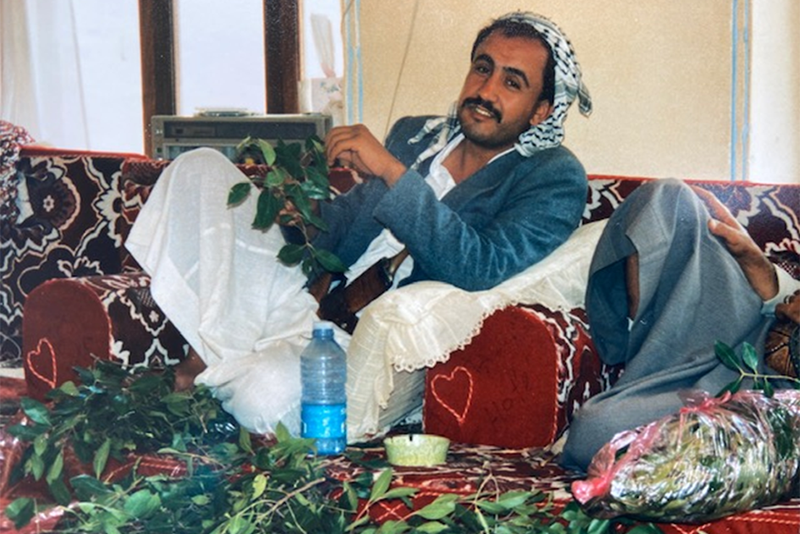
In the mountains between the coast and Sana’a, villages were built like eagles’ nests on mountaintops. High walls rose from the mountain to the sky. In the narrow streets between the walls there was just enough room for the donkeys, which were used on the terraced fields. As we wandered through the streets of such a mountain village, we were pelted with stones by the village youth. Different-looking people were probably so threatening that they had to be dealt with quickly. The shout of “aib” worked wonders. They stopped throwing. The houses in the eagles’ nests were built in the characteristic Yemeni architectural style. The lower floor had no windows and a sturdy wooden gate. This was where the cattle were housed. The floor above had a few windows. This was where the supplies were stored. Up another flight of stairs were the sleeping quarters. More windows on this level. Even higher were the kitchen and the women’s quarters. On the top floor was the mafradj, a large room that took up the entire floor. The mafradj had large windows with colored glass at the top, through which beautifully filtered light came in. Soft cushions were placed along the walls. This was the domain of the men. This was where meetings were held and – the main activity – qat was chewed. Our hostel had a real mafradj. This was the perfect time to chew qat. We didn’t really know how to acquire a bunch. Perhaps the Yemenis didn’t want to sell it to foreigners. Brahim was kind enough to buy some bunches for us and gave us instructions on how to chew. After some discussion about whether I, as a woman, was allowed to sit in the mafradj, we nestled in the mafradj’s cushions and put the leaves in our cheek pouches. The leaves tasted bitter. It turned out to be a matter of perseverance. Keep grinding the leaves between your teeth and drinking a lot of water so that a ball formed in your cheek pouch. I peered at the men around me. Most of them had stretched cheeks like a jazz trumpet player. They were sitting quietly chewing and talking. After an hour of hard chewing, the first signs of activity began to show. We became cheerful and knew solutions to all the world’s problems. Life was good. It was not for nothing that disputes in Yemen were settled during qat sessions. While chewing, I came up with a great invention on the spot: the vacuum cleaner bottle. Afterwards, I could no longer think of what this could be, but the word had stuck. During this alert phase of chewing, I was determined to organize qat courses for burnout general practitioners. When I came to my senses again, this idea seemed less successful.
After an hour of being in this ecstasy we entered another phase. Actually, nothing mattered to us anymore. We hung on the cushions in the soft evening light and let things around us take their course. Just then a few German tourists entered the mafradj. They had just arrived and were urgently looking for a place to sleep. In our eyes they were walking around there with a lot of fanfare. With languid glances we followed the troublemakers. What were these people so worried about? The innkeeper was in the same condition as we were. He was not very inclined to let himself be pulled out of his exalted state. The German actions therefore had little effect. The Germans slunk away dissatisfied and went downstairs to wait until the idiots in the mafradj were able to speak again. Gradually the fog in our minds lifted a bit. Food was served and men arrived with musical instruments. The atmosphere was peaceful. The Germans were allowed to join us. The meal and the drums made us excited and we danced along with the mafradj. When we got to the bedroom, we were still in a fantastic mood. We had completely lost our sleep and Daniel and I had deep conversations until dawn. We caught up on our sleep the next day on the back seat with Brahim.
Back in Sana’a we bought incense and daggers at the market by the big city gate. There was a beautiful little balcony at a restaurant. The balcony was narrow and had room for a long bench, from where the guests had a beautiful view of the bustling market below them. We drank a fruit drink and mused about life in Yemen. The man sitting next to Daniel nudged him and carefully asked why his wife was not wearing a headscarf. Of course he could not have known that I was not Daniel’s wife but his sister. My brother explained that that was not our custom. The man thought it was strange. During later trips I sometimes tried to adapt by wearing a headscarf. I had been given a beautiful one by a Turkish patient, who had brought it for me from the Hajj in Mecca. In Syria I tried to put the cloth on neatly. It was not for me. The thing did not stay on properly. I thought with admiration of the women in my circle of acquaintances, who know how to keep the cloth beautifully in check with pins. I came to the conclusion that I should just be the way I was in the hope that others would not find that too strange. And the same goes the other way around.